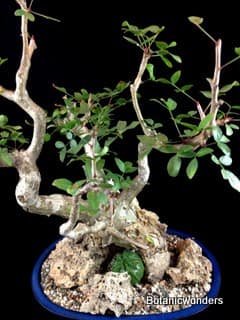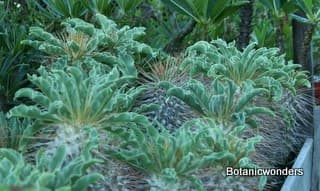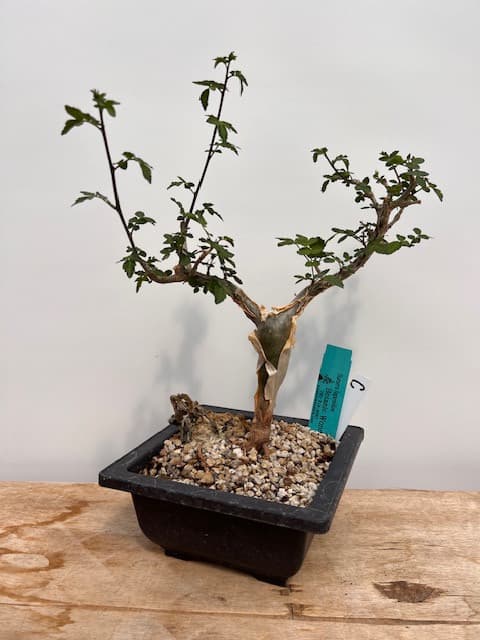
I started this Bursera fagaroides as a one-inch cutting on 2019-03-14. The cutting was a tip pruning from a parent plant I had been growing for eleven years at that point, taken on a quiet Thursday morning while I was clearing winter dieback off the bench. It is now a six-inch specimen, photographed against the dark backdrop on 2026-04-30, the day I sat down to write this. Seven years to a six-inch tree. That sentence contains everything you need to know about working with this genus.
The slow ones teach you the most. Bursera does not respond well to forcing. You cannot push it with fertilizer the way you can push a juniper, you cannot wire it into a shape in a single afternoon the way you would shape a pine, and you cannot crowd-prune it back to a stub and expect a vigorous response. The wood is soft and resinous, the bark is paper-thin and aromatic — split a young branch and the air around the bench fills with a smell somewhere between citrus peel and frankincense — and aggressive intervention leaves permanent scars that the tree will carry for the rest of its life. Every cut you make is forever.
Which means the practice is mostly about restraint. The single most important thing I have learned in seven years of working this tree is that doing less, more slowly, with longer rest periods between interventions, produces a better tree than any amount of aggressive shaping. The bonsai community sometimes calls this the patience approach. I would call it the only approach that works for this genus.
Propagation from cutting is the standard starting point for Bursera bonsai, because seedlings take fifteen to twenty years to develop the bark character that makes the genus visually interesting, while a cutting carries the parent's bark and branching habit from day one. Take cuttings in late winter, just before the spring flush, from healthy semi-hardwood stock. Length matters less than caliper — a cutting the thickness of a pencil and three to five inches long roots more reliably than a thinner whip. Cut at a 45-degree angle just below a node with a sterilized blade. Set the cutting on the bench in dry shade for 48 hours so the cut surface callouses over.
Strike the cutting into a 4-inch terracotta pot in pure coarse pumice — no coir, no fertilizer, no rooting hormone needed. Water once at striking and then not again for two weeks. Bursera roots from the callous and from the basal node, and any standing moisture during this period rots the cutting from the bottom up. After the first two weeks, a light watering once a week through spring is enough. By the end of the first growing season, the cutting will have a small root system and three to five new leaves. Do not repot. Do not prune. Do not move it. Year one is for survival.
Year two is when structure pruning begins, and from year two onward the practice is one structure prune per year, performed in late February just before the spring flush. Two cuts. Maybe three. Done. I cannot emphasize this enough. The temptation, every year, is to make four cuts instead of three because the tree looks like it could take it. It cannot. The tree responds to your restraint, not to your enthusiasm.
The first structural cut on this fagaroides was made in February 2020, eleven months after striking the cutting. The cutting had produced a single dominant leader and two side branches, all roughly equal in length. I cut the leader back to the second node, which moved apical dominance into one of the side branches and changed the trunk line from a straight vertical into a slight curve. That single cut, made when the tree was less than three inches tall, defined the silhouette of every photo taken since.
Year three brought the second structural cut — removing a low side branch on the convex side of the trunk curve to open the visual line. Year four brought the first taper cut, shortening a branch that had grown disproportionately long during a particularly wet spring. Year five was a rest year with no cuts at all, intentionally, to let the tree consolidate the previous three years of work. Year six brought the first apical pinching to begin building ramification in the canopy. Year seven, this past February, was a single cut to remove a crossing branch.
Wiring is something I do almost never on Bursera, because the bark is so thin that wire bites in within four to six weeks regardless of how loosely you set it, and the resulting scars take three to five years to grow out. The exception is when a young branch has set in an unusable angle and there is no other way to correct it. In that case I use the lightest aluminum wire I have, set it loosely, and remove it within three weeks regardless of whether the branch has set. Better to repeat the wiring next year than to scar the bark.
The trunk training itself happens almost entirely through the choice of which leader to cut and which side branch to promote. Over seven years, the trunk on this tree has moved through four distinct silhouettes — straight vertical, slight curve right, balanced S-curve, and the current asymmetric leaning form. Each silhouette was set by a single cut at the start of a season. The tree did the rest of the work over the following twelve months.
Watering through the active season is straightforward. Water deeply when the top inch of soil dries to the touch, which in our greenhouse during the active phase works out to every five to seven days. The mix matters more than the schedule — we use the same 60/40 pumice and coir mix as the rest of the caudiciform bench, with the addition of a thin layer of decomposed granite on top to keep the surface looking clean and to slow evaporation around the trunk base. Light is full sun, all day. Bursera tolerates a remarkable range of light conditions but produces the best bark character and the most compact internodes when grown in unfiltered direct sun.
Dormancy in our climate begins in late October with leaf yellowing and runs through mid-February. During dormancy the tree gets reduced water — roughly once every three weeks, just enough to keep the fine roots from desiccating completely — and zero fertilizer. The bark continues to develop through dormancy even without active leaf growth, which is one of the genus's most appealing properties. Hardiness sits at USDA 10 through 11, and we move the trees under cover for any forecast night below 38°F.
Repotting cadence on a Bursera bonsai is every two to three years for young trees and every three to four years for mature trees, performed in late February just before the structural prune so both interventions can be made on a single day and the tree only has one recovery period. Slide the tree out, work spent mix off the roots, prune any black or hollow root material, and prune the longest healthy roots back by approximately a third to maintain a compact root mass. Pot up dry in fresh mix and wait ten days before the first watering.
The pot itself is part of the work, and choosing the right pot at each stage of a bonsai's development is its own discipline. This fagaroides has lived in four pots over seven years. The first was a generic 4-inch terracotta nursery pot, used through year two. The second was a slightly oversized 5-inch unglazed pot in year three, chosen specifically to encourage root extension before the form was finalized. The third, in year five, was a high-fired Tom Glavich pot in muted oxide brown, 5.25 by 5.25 by 4 inches. The current pot, set in February 2026, is a Jerry Garner high-fired pot, 7 by 5.25 by 3.25 inches, in a slightly cooler glaze that suits the silvered bark the tree is now developing.
Each pot transition was made when the tree's proportions outgrew the previous container, and each was chosen to set up the proportions for the following two to three years of growth. A pot too large pushes the tree to grow more vigorously and lose compactness. A pot too small starves the root mass and slows bark development. The visual rule of thumb is that the pot should read as roughly two-thirds the width of the canopy and one-third the height of the trunk, but that rule bends in every direction depending on the specific tree.
The discipline I have found most valuable, more so even than the annual structure prune, is photographing the same tree on the same date every year against the same backdrop. You think you remember what the tree looked like a year ago. You do not. The photos do. We have a folder of twelve photos of this tree, one per year for seven years, plus the original cutting photo and a handful of intermediate shots. Looking at the sequence is the most honest feedback loop I have for whether the work I am doing is improving the tree or just maintaining it.
If you want to start a Bursera bonsai today, here is what you need. A fresh cutting from documented parent stock, which we sell in 3.5-inch and 5-inch pots from our greenhouse — the 3.5-inch pots in particular are well-suited as starter material. A 4-inch terracotta pot. The standard caudiciform mix described above. A small bag of decomposed granite for the surface dressing. A pair of sterilized bypass scissors. And the willingness to leave the tree alone for the first year. Do not repot. Do not prune. Do not even rotate it. Water, watch, and wait. A camera helps. Patience is the actual material you are working with.
What to watch for. The failure modes for Bursera are different from those of caudiciform Pachypodium or Dioscorea, but they are equally consistent. Black resin weeping from a cut surface, which is a normal callous response and not a sign of trouble — it dries and seals within a week. Bark cracking through dormancy, which is also normal and is part of how the genus develops its mature character. Branch dieback during the active season, which usually means insufficient light or a recent overwatering and which is corrected by addressing both. Wire scars from forgotten wire, which never fully heal and which are entirely preventable by removing wire within three weeks. Root rot from heavy soil, which is the single most common cause of catastrophic failure and which is prevented by sticking to the pumice-heavy mix described above. A tree that has not visibly grown in two years, which usually means the pot has become too restrictive and is correctable with a routine repot.
The tree in the photo at the top of this article is the result of doing the work above, seven times in a row, with no shortcuts and very few interventions. There is nothing exceptional about the technique. The technique is restraint. The exceptional thing is that the tree is itself, after seven years of careful attention, in a way that no faster process could have produced. That is the entire argument for working in this genus.

Al
Founder, Botanic Wonders. Thirty years growing rare and specimen plants in northern San Diego County.